85. Dorset Gardens Condo: Dorset Gardens Project Details at a Glance
Dorset Gardens is appearing on the Singapore resale and condo conversation circuit as the marketing name for an upcoming condominium project on Dorset Road, in District 8. From the project clues that have surfaced, it is tied to a government land sale site at Dorset Road, and it is positioned in a familiar kind of buyer’s lane for the area: close enough to Farrer Park MRT for convenience, yet backed by the District 8 demand drivers that tend to keep transactions active.
Still, as with any new launch in its early marketing phase, there is a difference between what is confirmed in broad strokes and what buyers often want to know immediately, like confirmed pricing, unit mix, and exact specifications. What follows is a practical “at a glance” walkthrough of the project details that are grounded in the verified context available, plus the sensible questions to ask while you are deciding whether to book a viewing or request the brochure.
The project in plain terms: what Dorset Gardens refers to
“Dorset Gardens” is presented as the marketing name for an upcoming new condo project on Dorset Road in Singapore’s District 8, near Farrer Park MRT. This matters because it tells you two things at once.
First, the project is not a vague development teaser. It is linked to a specific land parcel and a government land sale context. Second, the naming suggests a push toward a lifestyle branding approach, rather than a purely descriptive address-based title. That typically signals a sales strategy where the marketing narrative, the showflat experience, and the brochure materials will do a lot of the heavy lifting.
If you are the type who prefers to anchor your decisions in tangible inputs, you will appreciate that the land sale linkage is not just rumour. The verified context indicates that a bid was awarded in October 2025 for S$524.3 million, which translates to an indicated S$1,338 psf ppr. Those figures are the kind of baseline that often influences how developers set pricing ranges, yet it is still important to remember that developers can adjust their approach later depending on construction costs, financing conditions, and the sales demand they see around the launch period.
Who is the developer: consortium background and ownership split
One of the most useful pieces of verified information is the consortium structure behind the project. The site was won by a consortium of UOL, Singapore Land Group (SingLand), and Kheng Leong Company. One source indicates a JV shareholding split of UOL 60%, SingLand 20%, and Kheng Leong 20%.
In practice, this ownership split does not automatically tell you the exact interior finish level or the exact pricing strategy, but it does help you interpret who is driving the project’s development culture and execution style. UOL is a familiar name in Singapore’s property landscape, and buyers typically associate established developers with more consistent project delivery. That said, the only defensible stance at this stage is to treat ownership as a “signal,” not a guarantee. The final story still shows up in the sales documentation and, ultimately, in what you see during viewings.
Acquisition timing and the “be careful with branding” note
The context https://dorsetsgarden.com.sg/ includes a UOL annual report statement that the group completed acquisition of the residential site at Dorset Road in January 2026 via a joint venture with Kheng Leong and CapitaLand Group. However, it is also explicitly flagged that this appears to refer to a separate or later project context, so it should be treated cautiously against the Dorset Gardens branding used by other property pages.
For buyers, this is a real-world lesson: marketing name alignment is not always perfectly one-to-one with every corporate milestone described in public reports. When a brand name is involved, it can cover different stages, partnerships, or even entirely different projects in the same general geography. So while the annual report statement is not something you should ignore, you also should not assume it is describing the exact same Dorset Gardens development without matching the project identifiers during your brochure review or appointment booking.
A good way to handle this is simple: when you request the brochure or the price list, confirm the project title as it appears in the official documents you are given, and make sure the developer entity details match the information stated on the appointment or booking page.
Land parcel scale and location advantages that show up in marketing
The context describes the site as roughly 10,399 sq m. It also indicates the development is next to Farrer Park MRT Station and near schools such as St Joseph’s Institution.
Location is where buyer priorities become very personal, but the practical implications are consistent. Being next to Farrer Park MRT typically means:
- Easier weekday commuting for many city-route destinations.
- A steady stream of rental demand from tenants who value mobility.
- A higher likelihood of convenience shops and food options within normal walking or short ride distances.
Meanwhile, being near established schools is often a separate factor that affects family decisions. Schools influence not only owner-occupier demand, but also how buyers think about long-term resale prospects in neighbourhoods that retain family-driven demand.
Tenure and building form: what is planned
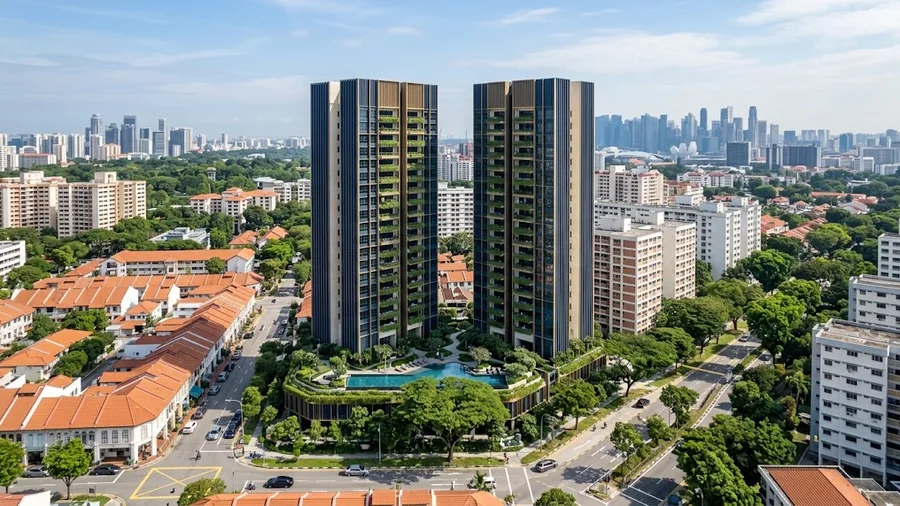
One verified source describes the development as a 99-year leasehold condominium with about 428 homes across two 27-storey towers.
Those details are meaningful for both lifestyle and investor considerations.
Leasehold tenure changes how you think about holding period and resale timing, because many buyers use tenure awareness as a screening criterion. Two towers, 27 storeys each, with about 428 homes suggests a mid-density project, not a tiny boutique scheme, which tends to affect facilities planning and the overall “feel” of the development. A project with a larger home count also changes how you imagine peak-hour usage: lifts, common areas, and arrival timing around main drop-off points.
At the same time, “about 428 homes” and the general building description are still early, high-level figures. The brochure or price list registration package may present exact counts and confirm the precise tower and unit distribution, especially if the development concept evolves through approvals and final design staging.
The land sale bid, psf ppr, and what that usually influences
The bid award in October 2025 for S$524.3 million, or S$1,338 psf ppr, is one of the clearest pricing pressure indicators in the verified context. Even without knowing the final pricing schedule, you can understand why developers and marketing teams pay attention to that benchmark. The psf ppr figure acts like a bridge between land cost and sellable area economics.
However, it is also where buyers can misread signals if they are too literal. Two common trade-offs happen during launches:
- The project’s final selling price is not set by land cost alone. Financing terms, construction package pricing, and the developer’s target buyer segment matter.
- Launch pricing can shift over time based on buyer interest during preview periods, and the sales team may adjust how they position bundles like stack choices or floor levels.
So, treat the S$1,338 psf ppr as context for understanding potential pricing logic, not as a promise that any exact number will appear in the price list.
What “project details” you can realistically expect from marketing pages
The verified context mentions that public listing pages for Dorset Gardens or Dorset Road GLS advertise brochure downloads, price list registration, and showflat appointment booking. That tells you the typical funnel: marketing page, registration, brochure access, and showflat viewing.
It also clarifies something important for buyers who feel frustrated by the lack of posted numbers online. Those pages may not publish the final pricing openly. Instead, they funnel interested buyers into a controlled process, where the developer shares more detail after registration. You should expect that the brochure and any price list materials provided upon appointment will contain the most practical facts: what is being sold, how it is marketed, and what the official launch pricing framework looks like.
In this stage, the most sensible approach is not to guess. It is to treat the brochure as the primary source of truth for the details you actually need to decide.
Dorset Gardens developer strategy: a consortium product with multiple stakeholders
When you have a consortium that includes UOL, SingLand, and Kheng Leong, the project may reflect a blend of development sensibilities. Even if final product details are not publicly enumerated in the verified context, buyers can still infer a process reality: multiple parties align on design direction, financing, and commercial strategy.
That alignment can be beneficial for execution discipline, but it can also create slower decision cycles compared with single-developer projects. You notice this most during the “waiting period” that happens between land award and the visible launch marketing timeline.
So if you are considering booking, the pragmatic stance is to ask for an expected timeline during your appointment. If the brochure provides a launch preview window or an estimated timeframe, you can weigh it against your personal constraints, such as when you plan to sell an existing unit or when you need a place to move in.
What pricing information is known, and what is not
Based on the verified context, there is no reliable official developer brochure or a final confirmed pricing schedule presented openly in what was reviewed. There are marketing references to “direct developer price,” “price list,” and launch-preview registration.
This is a critical boundary. It means you can think about “how pricing might be shaped,” but you cannot safely claim exact pricing numbers or launch amounts. Any attempt to do so would be guesswork, and guesswork is exactly how buyers get blindsided by the price they did not plan for.
If you want to stay grounded, focus on what you can confirm during registration and viewing:
- Whether the developer provides an official price list after registration.
- Whether pricing is broken down by stack, floor level, and unit type.
- Whether the “direct developer price” framing comes with any stated discounts or promotions.
If you are comparing against other launches in District 8 or nearby areas, use confirmed brochure figures rather than comparing against rumours.
Why the “showflat view” matters more than people expect
People often treat a showflat as a place to appreciate finishes and layouts. That is true, but from a decision standpoint, showflat viewing is also where you learn about how a developer expects you to see the product.
For example, you might notice how the sales team positions:
- the two-tower massing,
- the expected daily movement from transport access,
- and the way common spaces are imagined to support day-to-day living.
Even without exact numbers, the showflat can help you sanity-check whether the unit layouts feel realistic for your lifestyle. One lived experience point that buyers learn quickly: a plan that looks fine on paper can feel cramped when you see where door swings are, how corridors funnel movement, and how the living space transitions to the kitchen.
In other words, you are not just evaluating aesthetics. You are assessing practical livability.
A buyer’s decision checklist for Dorset Gardens materials (no guesswork)
If you are deciding whether to book Dorset Gardens view showflat and request the Dorset Gardens brochure, the best checklist is not long, but it should force the right clarifying answers. Here are the most useful items to confirm, based on what the verified context says is typically distributed through the marketing funnel:
- confirmed tenure and home count, including whether the “about 428 homes” figure is presented as exact
- unit mix and how the two 27-storey towers are organised in the sales plan
- how price list access works after registration, and whether any indicative pricing is provided upfront
- what stack or floor-level details are available when you request the view
- whether the developer entity and project identifiers match the Dorset Gardens marketing name in the official documents
You do not need to ask everything at once. If you start the appointment with these points, the conversation stays on track instead of drifting into general marketing talk.
The trade-offs: what you gain and what you must accept with leasehold
A 99-year leasehold condominium is not inherently a deal-breaker, but it changes the way many buyers evaluate long-term value. Leasehold decisions are often emotional in the beginning because people focus on the lifestyle benefits and the location. The reality hits later when resale horizon and buyer perception come into play.
The trade-off you are accepting with leasehold is time-based. A good leasehold purchase can still be a smart move if it matches your plan horizon and if the neighbourhood demand remains stable. But you should not ignore the tenure factor when comparing against freehold alternatives elsewhere, or even other leasehold launches that might offer different tenure lengths.
Also, density matters. With two towers and about 428 homes, the project will likely have a strong “community life” element. That can be a plus for owner-occupiers. For investors, it can also mean a more liquid rental market. But it also suggests facilities will be designed for a larger crowd, so it is worth checking how the developer positions shared amenities in the brochure you receive.
Location near Farrer Park MRT: commuting, rentals, and everyday friction
Being next to Farrer Park MRT is a verified locational fact in the context. From a practical perspective, you get more than commuting convenience. You get:
- Reduced “time cost” on weekdays, which often means you are less likely to stay out longer purely because you can get home quickly.
- A wider tenant audience for rentals, because MRT access is a core requirement for many working professionals.
- Easier errands and school-related travel, especially for families who juggle schedules around school timing and after-school activities.
The friction points are not eliminated, though. MRT-adjacent areas still have peak-hour crowd patterns, and certain unit orientations can influence how much you feel the transport presence depending on building placement and facade planning. That is another reason why seeing the showflat or reviewing unit positioning details matters. You want to understand how the development’s layout translates into a daily experience.
The best way to use this “at a glance” summary
If you remember only one practical idea from all of this, let it be this: treat Dorset Gardens as a confirmed project concept with verified high-level parameters, while keeping your decisions anchored to what the developer’s materials confirm during registration.
Right now, the verified foundation includes:
- Dorset Gardens as a marketing name for an upcoming condo on Dorset Road in District 8 near Farrer Park MRT
- the consortium background involving UOL, SingLand, and Kheng Leong, with an indicated JV split of UOL 60%, SingLand 20%, Kheng Leong 20%
- an October 2025 bid award of S$524.3 million, or S$1,338 psf ppr
- planning details described as 99-year leasehold with about 428 homes across two 27-storey towers
- location context like being next to Farrer Park MRT and near schools such as St Joseph’s Institution
- marketing funnel behaviour around brochure downloads, price list registration, and showflat appointment booking
- the absence of an openly confirmed final pricing schedule in the reviewed materials
That combination is enough to support a serious next step, like booking an appointment, without pretending you already know the final numbers.
What to do next if you are considering Dorset Gardens
If you are keen, the most efficient move is to request the brochure through the showflat appointment and price list registration process that the marketing pages advertise. In practical terms, this puts you on the same timeline as other serious buyers and ensures you get the official materials rather than relying on partial references.
When you meet the sales team, keep your questions specific. Ask about what is included in the brochure, how the price list is structured, and which stacks are likely to match the unit type and floor level you want. If you are comparing units across different launches, resist the urge to decide based on marketing narratives alone. Use the brochure and price list as your anchor.
And if anything about the project identifier or developer entity details feels inconsistent with the Dorset Gardens marketing name, pause and clarify. The verified context already cautions that corporate milestones can sometimes refer to adjacent or separate contexts, so you do not want to base your decision on assumptions.
If you want, tell me what you care about most, for example near MRT, school proximity, leasehold tolerance, or unit size, and I can help you translate the verified project details into a tighter shortlist of what to ask during your Dorset Gardens brochure and showflat appointment.